To be, or not to be: that is the question:
Whether ’tis nobler in the mind to suffer
The slings and arrows of outrageous fortune,
Or to take arms against a sea of troubles,
And by opposing end them? To die: to sleep;
No more; and by a sleep to say we end
The heart-ache and the thousand natural shocks
That flesh is heir to, ’tis a consummation
Devoutly to be wish’d. To die, to sleep;
To sleep: perchance to dream: ay, there’s the rub;
For in that sleep of death what dreams may come
When we have shuffled off this mortal coil,
Must give us pause: there’s the respect
That makes calamity of so long life;
For who would bear the whips and scorns of time,
The oppressor’s wrong, the proud man’s contumely,
The pangs of despised love, the law’s delay,
The insolence of office and the spurns
That patient merit of the unworthy takes,
When he himself might his quietus make
With a bare bodkin? who would fardels bear,
To grunt and sweat under a weary life,
But that the dread of something after death,
The undiscover’d country from whose bourn
No traveller returns, puzzles the will
And makes us rather bear those ills we have
Than fly to others that we know not of?
Thus conscience does make cowards of us all;
And thus the native hue of resolution
Is sicklied o’er with the pale cast of thought,
And enterprises of great pith and moment
With this regard their currents turn awry,
And lose the name of action. – Soft you now!
The fair Ophelia! Nymph, in thy orisons
Be all my sins remember’d.
William Shakespeare – To be, or not to be (from Hamlet 3/1)
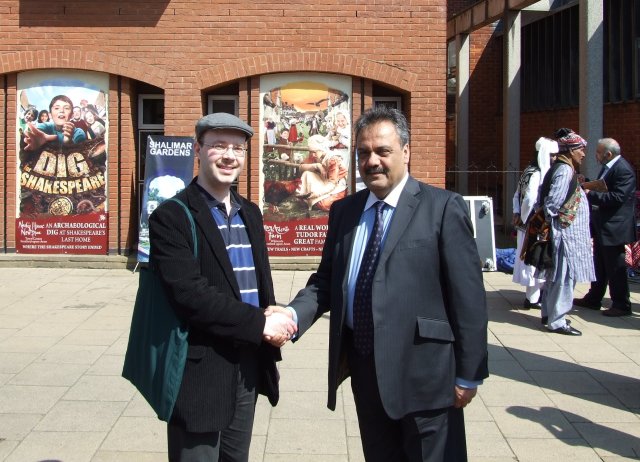
Mr Paul Salahuddin Armstrong, Director for Interfaith and Interpolitical Dialogue at the Association of British Muslims, meeting Mr Asif Durrani, Deputy High Commissioner for Pakistan, at the Shakespeare-Iqbal Festival of World Poetry & Music, in Stratford-upon-Avon, 23 April 2010. (Click image for slideshow)
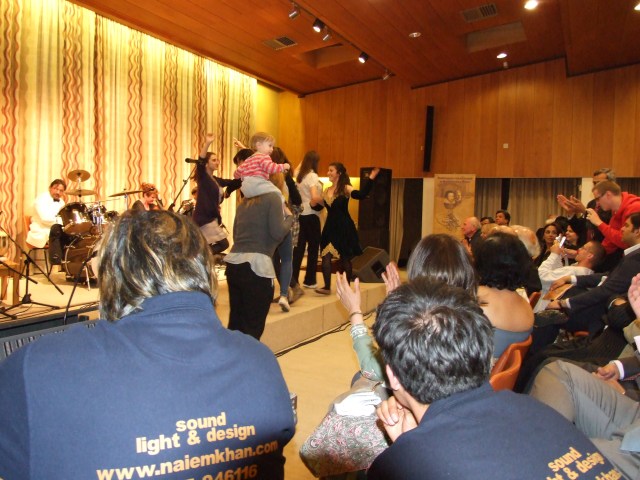
Cultural Performance by renowned Artistes from Pakistan, to pay tribute to famous Poet-Philosopher of the East Dr. Sir Muhammad Iqbal and to Commemorate Shakespeare's Birthday. (Click image for slideshow)
“One of the lessons we have already begun to learn is the almost uncanny universality of the religious experience. Men and women may express their faith in different terms, but there is an underlying and profound similarity beneath all the differences. We now realise that the great religions of the world are not monolithic institutions but that they all contain several spiritualities – many of which are found right across the board of the world religions – which reflect different attitudes of mind towards our ultimate end. Mysticism is one such spirituality, found in all religions and is a startling example of this deep unity of the religious vision. Mystics often have different beliefs which inevitably affect their experience. They will describe their interior journeys in terms of the orthodox traditions of their faith: Jews, Christians and Muslims, for example, believe in a personal God while Buddhists feel that this is an unreligious idea and prefer to speak of an ultimate but indescribable Reality. But the actual experience of all mystics is strikingly similar: all encounter a reality in the depths of the self, which is, paradoxically, Other and irrevocable separate from us. All emphasise that this ultimate reality, which gives meaning and value to human life, is ineffable, transcending our limited words and concepts. Mystics are aware that their experience can never be explained in rational terms and insist that it is unhelpful and can even be dangerous to attempt to define the ultimate reality in terms of reason and logic. They encounter a presence which transfigures their lives and, provided that they are temperamentally suited to this type of religious activity and have the benefit of expert advice, they experience a satisfaction which is real but inexpressible. They feel that they have transcended the confines of their limited and isolated egos and also feel that they have been somehow absorbed into the ultimate truth and are at one with the world.
People who have no religious faith find this baffling, but it would be wrong to dismiss the mystics as deluded and credulous. However one chooses to interpret it, the mystical experience has been a fact of life, once human consciousness has developed to a certain point.”
– Introduction to THE ENGLISH MYSTICS OF THE FOURTEENTH CENTURY by Karen Armstrong (ISBN 1856260232)
The Sunnah (example/way of The Prophet, peace be upon him), is something we should live by, this is how we can honour our Prophet (pbuh). Too often, Muslims talk about outward aspects of the Sunnah, such as Arabic style clothing, or miswaks; without following the most important aspects of the Sunnah, starting with our intentions, treating people right, being kind, loving and being just! How often do we question ourselves, “am I really Muslim (obeying Allah)”? Many make the claim, without striving for the reality of Islam… Islam is not a social club, a tribe or exclusive fraternity! Rather Islam is a state of being, and the one who achieves this state is a Muslim!
An opportunity to learn and understand more about the needs of Muslims with disabilities.
Kitaba and Deaf Dawah have worked closely in organising the events ‘Islam – Access for All’. Join us for an evening with Shaykh Abdul Aziz*, who will lead discussions on the legacy of Islamic teachings on islam and disability. This will hopefully allow us to realise our Islamic duties towards others as individuals and as members of the community. The mosque has and will always be the heart of the muslim community, thus has a responsibility in making such individuals feel a sense of belonging.
We hope that these talks will be an inspiration in making all our mosques more accessible. All are welcome to attend. Disability access will be available. A BSL interpreter will also be present.
*Shaykh Abdul Aziz is a special needs teacher, who has also studied the traditional islamic sciences in various places including Hijaz, Yemen and East Africa
Why can’t I denounce Hamas, without being seen by some as anti-Palestinian and confused about Islam? Yet, the very same people who accuse me, deny Israel’s right to exist and even Hamas’ crimes against their own people!
Just to clarify, I’m neither anti-Israeli, anti-Palestinian, anti-Semitic, anti-Arab, anti-Jewish or anti-Islam! I arrived at my conclusions through following the Israeli-Palestinian conflict over many years. At one time, many years ago, I used to be very pro-Palestinian cause and quite anti-Israeli. But how can I support such a position, in light of a holistic understanding of this conflict? To do so, would be to deny the many atrocities of Palestinian groups like Hamas, together with the gross corruption and incompetence of many tinpot Arab regimes!
The Palestinian conflict, is used to redirect the attentions and energies of suppressed populations, away from the inadequacies of many supposedly Muslim countries, against the so called “Zionist regime”. Hence, delaying the much needed revival and restructuring of many of these corrupt nations. Yet, for all it’s faults, this so called “Zionist regime” is a modern democracy, with one in five of it’s citizens of Arab origin, who are accorded more rights and often a better quality of life, than in neighbouring Arab states. The third holiest site in Islam, Al-Aqsa Mosque and the Dome Of The Rock are still administered by Muslims, even though they are located in territory governed by Israel.
So what is this conflict really about? Isn’t it time Muslims woke up and stopped allowing themselves to be used, in the corrupt power games of tinpot regimes? Seriously, don’t we have faith in Allah? Why don’t we uphold truth, ethics, morality and justice? True justice isn’t about sticking up for someone because they claim to be Muslim! Justice is about seeking a fair and ethical resolution of a conflict, regardless of whether those involved are Muslim or not. Justice has nothing to do with any particular religious affiliation.
During the time of Imam Ali, peace be upon him, an Islamic Shariah court ruled in favour of a Jew who was actually in the wrong, but there was no evidence against him other than the word of the Amir-ul-Mumineen, Hazrat Imam Ali. Due to the fair and just way the trial was conducted, this Jewish person was so awestruck, he embraced Islam and returned Imam Ali’s armour! Where is this spirit of Islamic justice and fair play in today’s world? Do we wonder why Muslims are suffering all over the world? Have we even considered for one moment, how much of this is of our own doing?
How can brainwashing impressionable young children to hate and kill be justified? Not only Hamas but the Taliban and other terrorist organisations too, use the same evil tactics. How they have the audacity to claim any connection to Islam is beyond me!
What good are keys, if the houses are gone? Such mindless propaganda! Surely a good parent or grand-parent, would point out as everything is broken here, you may as well emigrate and make a better future for yourself elsewhere? All the world belongs to God and is permissible for a Muslim to live in. Why teach children to destroy themselves and others? I pity these poor children, may God protect and guide them.
Shaykh-ul-Islam Dr Muhammad Tahir-ul-Qadri, the founding leader and patron-in-chief of Minhaj-ul-Quran International, has issued his detailed edict (Fatwa) against terrorism which consists of more than 600 pages. The launching ceremony of the Fatwa was held on March 2, 2010 in London (UK). Minhaj-ul-Quran International UK arranged a press conference which was heavily attended by representatives of the international media besides Labour party minister Shahid Malik, members of EU and UK parliaments Sajjad Karim, Muhammad Sarwar, James Finter, ambassadors of Iraq, Germany and other countries, officials of the Home Office, Commonwealth Office and Metropolitan Police, Professors and Muslim and Christian community leaders.
Links to external, or third party websites, are provided solely for visitors' convenience. Links taken to other sites are done so at your own risk and Wulfruna Sufi Association accepts no liability for any linked sites or their content. When you access an external website, keep in mind that Wulfruna Sufi Association has no control over its content.
Any link from the Wulfruna Sufi Association website to an external website does not imply or mean that Wulfruna Sufi Association endorses or accepts any responsibility for the content or the use of such website. Wulfruna Sufi Association does not give any representation regarding the quality, safety, suitability, or reliability of any external websites or any of the content or materials contained in them. It is important for users to take necessary precautions, especially to ensure appropriate safety from viruses, worms, Trojan horses and other potentially destructive items.
When visiting external websites, users should review those websites' privacy policies and other terms of use to learn more about, what, why and how they collect and use any personally identifiable information.

 The Sunnah (example/way of The Prophet, peace be upon him), is something we should live by, this is how we can honour our Prophet (pbuh). Too often, Muslims talk about outward aspects of the Sunnah, such as Arabic style clothing, or miswaks; without following the most important aspects of the Sunnah, starting with our intentions, treating people right, being kind, loving and being just! How often do we question ourselves, “am I really Muslim (obeying Allah)”? Many make the claim, without striving for the reality of Islam… Islam is not a social club, a tribe or exclusive fraternity! Rather Islam is a state of being, and the one who achieves this state is a Muslim!






 Wulfruna Sufi Association